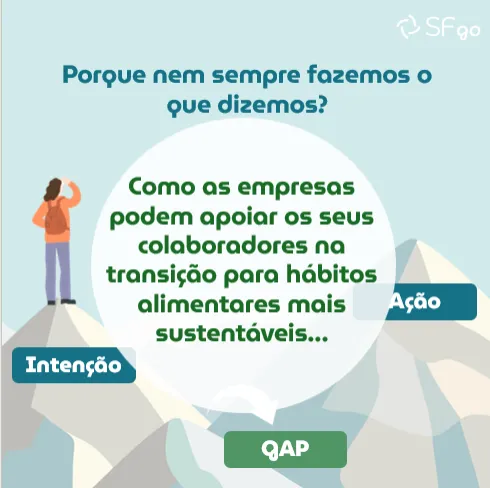
Environmental awareness is rising, yet a persistent gap remains between what people say they want to do and what they actually do. Many consumers claim they want to live more sustainably, but face barriers that prevent intentions from becoming action. This phenomenon—known as the Attitude–Behaviour Gap—is especially visible in food choices, where sustainable options are often perceived as inaccessible, complex, or unclear.
Recent studies show that:
-
People increasingly feel the impacts of climate change in their daily lives (GlobeScan, 2023).
-
There is growing expectation that companies should lead by example (Ingka / GlobeScan, 2025).
-
Health is one of the main motivators for sustainable choices (GlobeScan, 2023).
-
Lack of trust, insufficient support, and high product prices are among the top barriers to action (GlobeScan, 2021).
The role of companies: create conditions, not just communicate
Businesses have a decisive role in closing this gap. It is not enough to inform; they must create contexts that make sustainable choices easier. This starts at home, with their people. It’s not only about teaching “what to do,” but about ensuring the good choice is the easy choice, both inside and outside the company. When people and organizations move closer and align efforts, the gap between what we say and what we do begins—quietly—to narrow.
Investing in people: a strategic bet.
Investing in employee literacy and engagement is not just good practice; it’s a value-creating strategy. When people feel part of the change, they become active agents of transformation, inside and beyond the workplace. This approach strengthens corporate culture, boosts team engagement, and creates a virtuous cycle between purpose, well-being, and performance.
References
-
GlobeScan. (2023). Healthy & Sustainable Living Report 2023.
-
Ingka / GlobeScan. (2025). People and Planet Consumer Insights and Trends 2025.
-
GlobeScan. (2021). Healthy & Sustainable Living Highlights Report 2021.
-
EAT / GlobeScan. (2022). Grains of Truth 2022: A consumer report on healthy and sustainable food systems.
-
FAO. (2024). Greenhouse gas emissions from agrifood systems: Global, regional and country trends, 2000–2022. Food and Agriculture Organization of the United Nations.